
Universal Pipette Tips
Disposable pipette tips designed to fit single and multichannel pipettes from most manufacturers; offer acceptable performance compared to pipette specific tips and can be used with a variety of pipette models.
Single-use universal pipette tips are designed for compatibility with most mechanical and electronic single and multichannel pipettors.
Universal pipette tips are available in a range of types, sizes, colors, styles, and packaging configurations and may be designed for specific purposes or tasks.
- Capacity or volume based on the pipettor size
- Filters to reduce contamination and cross-contamination
- Color
- Sterility or autoclavability
- Tip style: beveled, tapered, wide bore, round, flat, or gel-loading
- Length: short or extended
- Purity: metal-free or DNase-, RNase-, ATP-, Bioburden-, PCR inhibitor-, endotoxin-, or pyrogen-free for genomic and biologic applications
- Surface treatments to reduce retention
- Packaging options to help facilitate re-stocking or eliminate waste

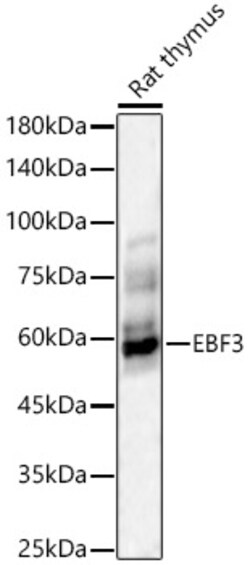
ABclonal Technology EBF3 Rabbit pAb

This gene encodes a member of the early B-cell factor (EBF) family of DNA binding transcription factors. EBF proteins are involved in B-cell differentiation, bone development and neurogenesis, and may also function as tumor suppressors. The encoded protein inhibits cell survival through the regulation of genes involved in cell cycle arrest and apoptosis, and aberrant methylation or deletion of this gene may play a role in multiple malignancies including glioblastoma multiforme and gastric carcinoma.

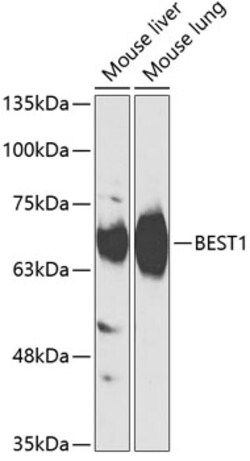
ABclonal Technology BEST1 Rabbit pAb
This gene encodes a member of the bestrophin gene family. This small gene family is characterized by proteins with a highly conserved N-terminus with four to six transmembrane domains. Bestrophins may form chloride ion channels or may regulate voltage-gated L-type calcium-ion channels. Bestrophins are generally believed to form calcium-activated chloride-ion channels in epithelial cells but they have also been shown to be highly permeable to bicarbonate ion transport in retinal tissue. Mutations in this gene are responsible for juvenile-onset vitelliform macular dystrophy (VMD2), also known as Best macular dystrophy, in addition to adult-onset vitelliform macular dystrophy (AVMD) and other retinopathies. Alternative splicing results in multiple variants encoding distinct isoforms.
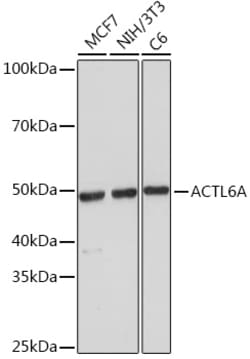
ABclonal Technology ACTL6A Rabbit mAb
This gene encodes a family member of actin-related proteins (ARPs), which share significant amino acid sequence identity to conventional actins. Both actins and ARPs have an actin fold, which is an ATP-binding cleft, as a common feature. The ARPs are involved in diverse cellular processes, including vesicular transport, spindle orientation, nuclear migration and chromatin remodeling. This gene encodes a 53 kDa subunit protein of the BAF (BRG1/brm-associated factor) complex in mammals, which is functionally related to SWI/SNF complex in S. cerevisiae and Drosophila, the latter is thought to facilitate transcriptional activation of specific genes by antagonizing chromatin-mediated transcriptional repression. Together with beta-actin, it is required for maximal ATPase activity of BRG1, and for the association of the BAF complex with chromatin/matrix. Three transcript variants that encode two different protein isoforms have been described.
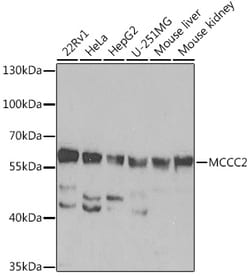
ABclonal Technology MCCC2 Rabbit pAb
This gene encodes the small subunit of 3-methylcrotonyl-CoA carboxylase. This enzyme functions as a heterodimer and catalyzes the carboxylation of 3-methylcrotonyl-CoA to form 3-methylglutaconyl-CoA. Mutations in this gene are associated with 3-Methylcrotonylglycinuria, an autosomal recessive disorder of leucine catabolism. Alternative splicing results in multiple transcript variants encoding distinct isoforms.
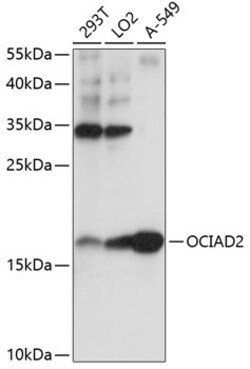
ABclonal Technology OCIAD2 Rabbit pAb
Predicted to be involved in endocytosis, hematopoietic stem cell homeostasis, and positive regulation of receptor signaling pathway via JAK-STAT. Predicted to act upstream of or within response to bacterium. Predicted to be located in Golgi apparatus, endosome, and lysosome.
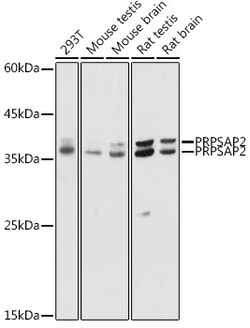
ABclonal Technology PRPSAP2 Rabbit pAb
This gene encodes a protein that associates with the enzyme phosphoribosylpyrophosphate synthetase (PRS). PRS catalyzes the formation of phosphoribosylpyrophosphate which is a substrate for synthesis of purine and pyrimidine nucleotides, histidine, tryptophan and NAD. PRS exists as a complex with two catalytic subunits and two associated subunits. This gene encodes a non-catalytic associated subunit of PRS. Alternate splicing results in multiple transcript variants.
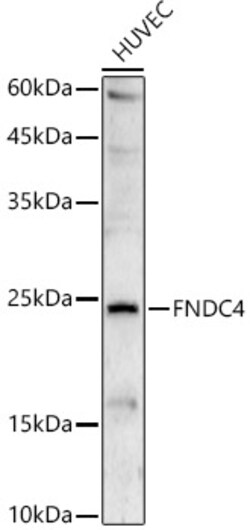
ABclonal Technology FNDC4 Rabbit pAb
Involved in response to transforming growth factor beta. Predicted to be located in endoplasmic reticulum and extracellular space. Predicted to be active in extracellular region and plasma membrane.
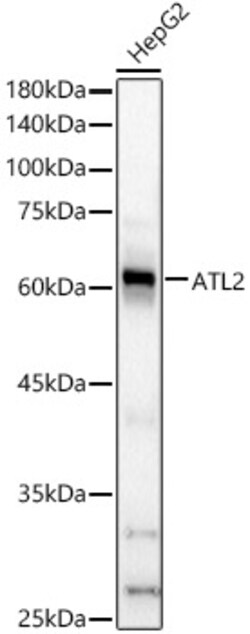
ABclonal Technology ATL2 Rabbit pAb
Enables identical protein binding activity. Involved in Golgi organization, endoplasmic reticulum tubular network membrane organization, and protein homooligomerization. Located in endoplasmic reticulum tubular network membrane. Is integral component of membrane.
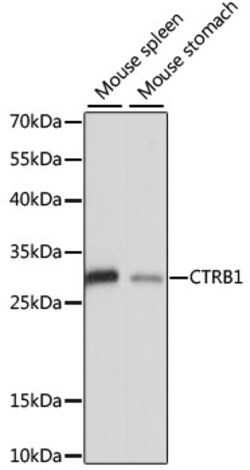
ABclonal Technology CTRB1 Rabbit pAb
This gene encodes a serine protease that is a precursor of pancreatic proteolytic enzymes. The preproprotein is synthesized in the pancreas and secreted into the small intestine, where it is activated to form the functional enzyme. The CTRB1 gene is located head-to-head with the related CTRB2 gene. Some human populations have a haplotype with a 16.6 Kb inversion region, swapping portions of intron 1, exon 1, and upstream sequences between CTRB1 and CTRB2. This inversion is linked to differential gene expression and an increased risk of chronic pancreatitis. The GRCh38 assembly represents the minor allele for SNP rs8048956 in CTRB1. SNP rs8048956 in intron 1 of CTRB2 is diagnostic for the inversion. The CTRB1 gene encodes distinct isoforms, which may undergo similar processing to generate the mature protein.
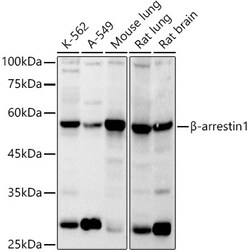
ABclonal Technology β-arrestin1 Rabbit pAb
Members of arrestin/beta-arrestin protein family are thought to participate in agonist-mediated desensitization of G-protein-coupled receptors and cause specific dampening of cellular responses to stimuli such as hormones, neurotransmitters, or sensory signals. Arrestin beta 1 is a cytosolic protein and acts as a cofactor in the beta-adrenergic receptor kinase (BARK) mediated desensitization of beta-adrenergic receptors. Besides the central nervous system, it is expressed at high levels in peripheral blood leukocytes, and thus the BARK/beta-arrestin system is believed to play a major role in regulating receptor-mediated immune functions. Alternatively spliced transcripts encoding different isoforms of arrestin beta 1 have been described.
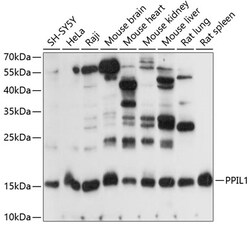
ABclonal Technology PPIL1 Rabbit pAb
This gene is a member of the cyclophilin family of peptidylprolyl isomerases (PPIases). The cyclophilins are a highly conserved, ubiquitous family, members of which play an important role in protein folding, immunosuppression by cyclosporin A, and infection of HIV-1 virions. Based on similarity to other PPIases, this protein could accelerate the folding of proteins and might catalyze the cis-trans isomerization of proline imidic peptide bonds in oligopeptides.
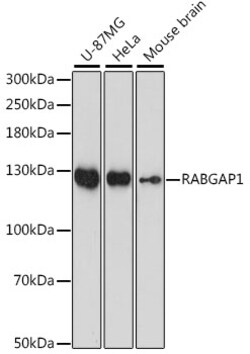
ABclonal Technology RABGAP1 Rabbit pAb
Enables GTPase activator activity and small GTPase binding activity. Involved in regulation of GTPase activity. Located in cytosol.
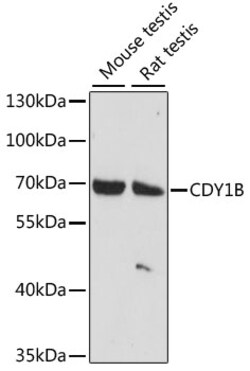
ABclonal Technology CDY1B Rabbit pAb
This gene encodes a protein containing a chromodomain and a histone acetyltransferase catalytic domain. Chromodomain proteins are components of heterochromatin-like complexes and can act as gene repressors. This protein is localized to the nucleus of late spermatids where histone hyperacetylation takes place. Histone hyperacetylation is thought to facilitate the transition in which protamines replace histones as the major DNA-packaging protein. The human chromosome Y has two identical copies of this gene within a palindromic region, this record represents the more centromeric copy. Chromosome Y also contains a pair of closely related genes in another more telomeric palindrome as well as several related pseudogenes. Two protein isoforms are encoded by transcript variants of this gene. Additional transcript variants have been described, but their full-length nature has not been determined.
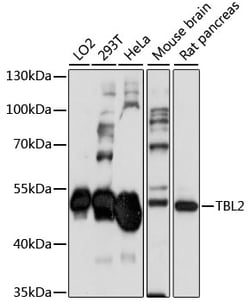
ABclonal Technology TBL2 Rabbit pAb
This gene encodes a member of the beta-transducin protein family. Most proteins of the beta-transducin family are involved in regulatory functions. This protein is possibly involved in some intracellular signaling pathway. This gene is deleted in Williams-Beuren syndrome, a developmental disorder caused by deletion of multiple genes at 7q11.23.
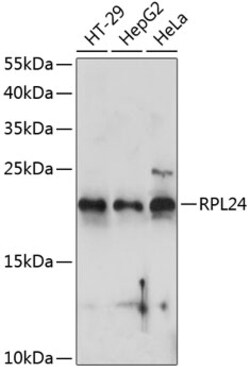
ABclonal Technology RPL24 Rabbit pAb
Ribosomes, the organelles that catalyze protein synthesis, consist of a small 40S subunit and a large 60S subunit. Together these subunits are composed of 4 RNA species and approximately 80 structurally distinct proteins. This gene encodes a ribosomal protein that is a component of the 60S subunit. The protein belongs to the L24E family of ribosomal proteins. It is located in the cytoplasm. This gene has been referred to as ribosomal protein L30 because the encoded protein shares amino acid identity with the L30 ribosomal proteins from S. cerevisiae, however, its official name is ribosomal protein L24. As is typical for genes encoding ribosomal proteins, there are multiple processed pseudogenes of this gene dispersed through the genome.